
经常用Claude Code的朋友都知道,在正式给模型提需求前,一定要写好CLAUDE.md文档,它决定了你用Claude Code进行Vibe Coding的风格和效率。CLAUDE.md是什么呢?
CLAUDE.md文档是为Claude Code提供项目特定上下文和指令的配置文件。这些文件充当项目的持久记忆(Memory),Claude Code在运行时会自动读取并添加到上下文中作为系统提示词(System Prompt)。
具体地,CLAUDE.md分为四个层级:
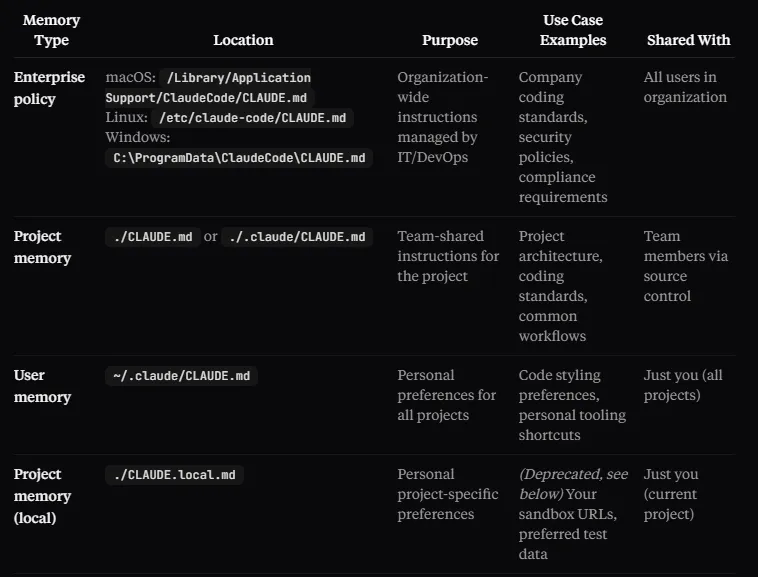
作为个人用户,我们只需要关注用户级别和项目级别的CLAUDE.md文档配置即可。其中用户级别的配置可以视作你的Claude Code编码全局配置,配置地址为~/.claude/CLAUDE.md,用于跨所有项目的全局指令。项目配置的CLAUDE.md可以直接放置在项目根目录下或者一些子目录下:./CLAUDE.md或.claude/CLAUDE.md。
CLAUDE.md文档一般可以包含编码指南和标准、项目特定上下文、常用命令或工作流程、API约定以及测试要求等信息。
可能有朋友就要问了,有没有现成的CLAUDE.md文档可以抄?那必须有。下面我把我珍藏了好几个月的全局配置CLAUDE.md分享给大家,这套全局配置浓缩了一个几十年经验开发者的开发风格,具体如下:
# Development Guidelines

## Philosophy

### Core Beliefs
- **Incremental progress over big bangs** - Small changes that compile and pass tests
- **Learning from existing code** - Study and plan before implementing
- **Pragmatic over dogmatic** - Adapt to project reality
- **Clear intent over clever code** - Be boring and obvious

### Simplicity Means
- Single responsibility per function/class
- Avoid premature abstractions
- No clever tricks
- choose the boring solution
- If you need to explain it, it's too complex

### Permission Management
Except for file deletion and database operations, all other operations do not require my confirmation.

## Process

### 1. Planning & Staging
Break complex work into 3-5 stages. Document in `IMPLEMENTATION_PLAN.md`:
```markdown
## Stage N: [Name]
**Goal**: [Specific deliverable]
**Success Criteria**: [Testable outcomes]
**Tests**: [Specific test cases]
**Status**: [Not Started|In Progress|Complete]
```
- Update status as you progress
- Remove file when all stages are done

### 2. Implementation Flow
1. **Understand** - Study existing patterns in codebase
2. **Test** - Write test first (red)
3. **Implement** - Minimal code to pass (green)
4. **Refactor** - Clean up with tests passing
5. **Commit** - With clear message linking to plan

### 3. When Stuck (After 3 Attempts)
**CRITICAL**: Maximum 3 attempts per issue, then STOP.
1. **Document what failed**:
   - What you tried
   - Specific error messages
   - Why you think it failed
2. **Research alternatives**:
   - Find 2-3 similar implementations
   - Note different approaches used
3. **Question fundamentals**:
   - Is this the right abstraction level?
   - Can this be split into smaller problems?
   - Is there a simpler approach entirely?
4. **Try different angle**:
   - Different library/framework feature?
   - Different architectural pattern?
   - Remove abstraction instead of adding?

## Technical Standards

### Architecture Principles
- **Composition over inheritance** - Use dependency injection
- **Interfaces over singletons** - Enable testing and flexibility
- **Explicit over implicit** - Clear data flow and dependencies
- **Test-driven when possible** - Never disable tests, fix them

### Code Quality
- **Every commit must**:
  - Compile successfully
  - Pass all existing tests
  - Include tests for new functionality
  - Follow project formatting/linting
- **Before committing**:
  - Run formatters/linters
  - Self-review changes
  - Ensure commit message explains "why"

### Error Handling
- Fail fast with descriptive messages
- Include context for debugging
- Handle errors at appropriate level
- Never silently swallow exceptions

## Decision Framework
When multiple valid approaches exist, choose based on:
1. **Testability** - Can I easily test this?
2. **Readability** - Will someone understand this in 6 months?
3. **Consistency** - Does this match project patterns?
4. **Simplicity** - Is this the simplest solution that works?
5. **Reversibility** - How hard to change later?

## Project Integration

### Learning the Codebase
- Find 3 similar features/components
- Identify common patterns and conventions
- Use same libraries/utilities when possible
- Follow existing test patterns

### Tooling
- Use project's existing build system
- Use project's test framework
- Use project's formatter/linter settings
- Don't introduce new tools without strong justification

## Quality Gates

### Definition of Done
- [ ] Tests written and passing
- [ ] Code follows project conventions
- [ ] No linter/formatter warnings
- [ ] Commit messages are clear
- [ ] Implementation matches plan
- [ ] No TODOs without issue numbers

### Test Guidelines
- Test behavior, not implementation
- One assertion per test when possible
- Clear test names describing scenario
- Use existing test utilities/helpers
- Tests should be deterministic

## Important Reminders
**NEVER**:
- Use `--no-verify` to bypass commit hooks
- Disable tests instead of fixing them
- Commit code that doesn't compile
- Make assumptions
- verify with existing code
**ALWAYS**:
- Commit working code incrementally
- Update plan documentation as you go
- Learn from existing implementations
- Stop after 3 failed attempts and reassess
- Always use context7 when I need code generation, setup or configuration steps, orlibrary/API documentation. This means you should automatically use the Context7 MCPtools to resolve library id and get library docs without me having to explicitly ask.
这个全局CLAUDE.md配置参考的是国外顶级开发者Chris Dzombak写的Claude Code深度使用经验总结,其中核心的开发哲学是:
渐进式改进而非一次性大改动:进行小规模修改并确保通过测试
从现有代码中学习:在实施前进行研究和规划
务实而非教条:适应项目实际情况
相信你用了这套配置,使用Claude Code来Vibe Coding的效率会有所提升。